Which One Fits Your Website Needs in 2025?
In today’s digital landscape, businesses need more than just a website. Your digital presence now extends to mobile apps, dashboards, smart devices, and multiple online channels. Therefore, choosing the right content management system (CMS) is a critical decision.
Many companies struggle to decide between a Traditional CMS and a Headless CMS. In this guide, we’ll break down the differences, highlight their advantages, and explain which is suitable for your business.
What is a Traditional CMS?
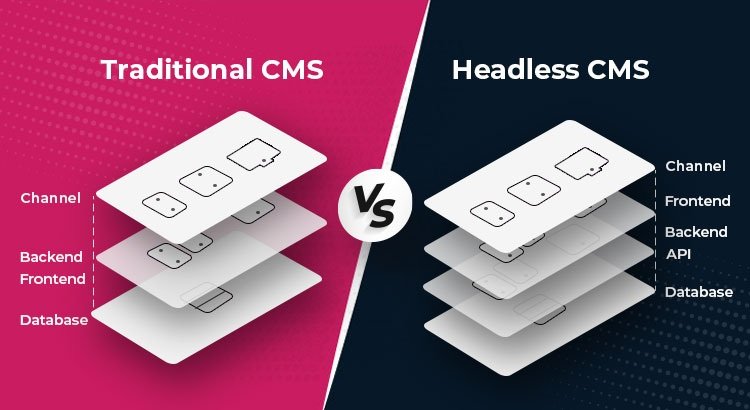
A Traditional CMS is an all-in-one system that combines the backend, frontend, templates, and content management in one place. This monolithic setup makes it easy for non-technical users to manage content.
- Ease of Use: With drag-and-drop editors, built-in themes, and WYSIWYG tools, you can quickly create web pages.
- Quick Setup: Beginners can get started without coding knowledge.
- Limitations: However, when businesses need multi-channel content delivery or advanced customization, traditional CMS platforms can feel restrictive.
Popular examples of traditional CMS include WordPress, Joomla, and Drupal. They are ideal for blogs, small business websites, and simple digital projects.
What is a Headless CMS?
A Headless CMS decouples the content backend from the frontend presentation. This means your content is stored centrally and delivered to multiple platforms via APIs.
Consequently, developers can build websites, mobile apps, smartwatches, dashboards, or smart displays using the frontend technology of their choice.
- Flexibility: Developers have full control over the user interface and can use frameworks like React, Angular, or Vue.js.
- Scalability: Headless CMS can handle large-scale websites, high traffic, and multi-platform content distribution.
- Content Reusability: One piece of content can appear on multiple channels without duplication.
- Performance: Loading speed improves because only the necessary content is delivered to each platform.
Popular headless CMS options include Contentful, Strapi, Storyblok, and Sanity.
Key Differences Between Traditional CMS and Headless CMS
| Feature | Traditional CMS | Headless CMS |
|---|---|---|
| Architecture | Monolithic, everything bundled together | Decoupled, backend and frontend separate |
| Content Delivery | Mainly web-focused | Omnichannel delivery via APIs |
| Design Flexibility | Limited by templates and themes | Full creative freedom using any framework |
| Developer Dependency | Low, easy for beginners | High, requires skilled developers |
| Scalability | Moderate, limited for large or complex projects | High, suitable for enterprise growth |
| Performance | Can be slower due to heavy structure | Faster and optimized, loads only necessary content |
| Security | Vulnerable if plugins or themes are outdated | More secure with custom frontends and API control |
| Cost | Lower upfront cost | Higher initial cost, justified for complex projects |
Architecture Matters
Traditional CMS platforms are built as all-in-one solutions. While convenient, this architecture ties the frontend and backend together. As a result, making design changes or integrating new platforms can be difficult.
On the other hand, Headless CMS separates content management from presentation, giving businesses the freedom to scale, redesign, or deliver content across multiple channels without structural limitations.
Content Delivery Across Multiple Channels
If your company plans to publish content on mobile apps, websites, IoT devices, or social dashboards, headless CMS is the clear winner.
Traditional CMS is primarily website-focused, which makes multi-channel marketing harder. Moreover, using the same content across platforms often requires duplicating work, which wastes time and resources.
Flexibility and Customization
With a traditional CMS, you are limited to predefined templates and plugin options. Customizing beyond these constraints can be technically challenging.
Conversely, a Headless CMS allows full creative control. Developers can craft unique user interfaces for each platform while keeping content centralized. This approach enhances user experience and supports brand consistency across channels.
Developer Dependency
Traditional CMS platforms are user-friendly and suitable for teams with minimal technical knowledge. On the contrary, headless CMS requires experienced developers to set up and maintain the backend and frontend separately.
However, the long-term benefits of flexibility, scalability, and multi-platform delivery often outweigh the initial complexity.
Scalability and Performance
For websites expecting high traffic or rapid content growth, traditional CMS platforms may struggle.
Headless CMS can handle large-scale websites and enterprise-level content delivery effortlessly. Additionally, because content is served via APIs, loading speeds are faster, which improves SEO, user experience, and conversion rates.
Security Considerations
Traditional CMS platforms are vulnerable if plugins or themes are outdated. Moreover, the interconnected frontend-backend structure creates a single point of failure.
Headless CMS reduces these risks. By separating the frontend and backend, businesses gain better control over security, minimizing exposure to attacks.
Which CMS Should You Choose?
For small websites, blogs, and simple business sites:
- A Traditional CMS is sufficient. It is easy to use and cost-effective.
For multi-channel experiences, custom interfaces, or enterprise-level scalability:
- A Headless CMS is the smarter investment. It ensures future-proof growth, performance, and flexibility.
Moreover, integrating a Headless CMS can improve your digital marketing strategy, content reusability, and platform adaptability.
SEO and Internal Linking Strategy
- Use internal links to your services pages or related blog posts, such as:
- Include external authoritative links for CMS tools:
- Optimize headings, meta descriptions, and images with focus keywords like:
- Traditional CMS vs Headless CMS
- Headless CMS benefits
- Multi-channel content delivery